
You’ve spent years optimizing for Google. Title tags, backlinks, keyword density. The whole playbook. But something has shifted. Your potential customers are now asking ChatGPT, Perplexity, Mistral, and Gemini for recommendations instead of scrolling through ten blue links. When someone asks “What’s the best lead generation tool for small businesses?” and your company doesn’t show up in the AI-generated answer, you’ve lost that prospect before they ever saw your website.
Traditional SEO gets you ranked. GEO gets you cited. And in 2026, being cited by an AI engine is becoming more valuable than ranking on page one.
What Are GEO and AEO
Let’s clarify three terms that often get mixed up:
SEO (Search Engine Optimization) targets traditional search engines to rank your pages in the classic “ten blue links.” You already know this one.
AEO (Answer Engine Optimization) targets direct answer systems like Google’s AI Overviews, featured snippets, and voice assistant responses. When Google pulls a direct answer from your site and shows it above all search results, that’s AEO at work.
GEO (Generative Engine Optimization) goes further. It optimizes your content specifically for large language models like ChatGPT, Claude, Mistral, Perplexity, and Gemini. These models don’t just show your link. Their retrieval systems surface content that is well-structured, authoritative, and relevant — and when they do, they may cite you as a source in their generated answers. The concept was formalized in a 2024 research paper from Princeton and Georgia Tech, which demonstrated that specific optimization strategies can significantly increase a page’s visibility in AI-generated responses.
The good news: GEO, AEO, and SEO are complementary. Most GEO improvements also strengthen your traditional SEO. Structured data, clear content architecture, and semantic HTML help both Google and AI engines understand your site.
The key difference: AI engines don’t send you traffic by default. They extract your information and present it directly. Your only chance of getting attribution (and the click) is if your content is structured, authoritative, and specific enough that the AI deems it worth citing.
This is what GEO is about. Not gaming an algorithm, but making your content so well-structured and useful that AI retrieval systems are more likely to surface and reference you.
Technical Foundation
These are the technical signals that determine whether AI engines can even find and parse your content. Start here. Most of these take hours to implement, not weeks, and they’re the highest-ROI items on this list.
You can check all of these instantly with our free GEO Ready Score tool. It runs 10 checks on your site and tells you exactly what’s working and what’s missing.
1. AI Crawler Access (robots.txt)
Your robots.txt file controls which bots can crawl your site. Many websites still block AI crawlers without realizing it. Check that you’re explicitly allowing the major AI fetchers used for citations (search and user-triggered fetch):
- OAI-SearchBot (OpenAI, ChatGPT Search citations)
- Claude-SearchBot and Claude-User (Anthropic, search + user-triggered fetch)
- PerplexityBot (Perplexity)
- MistralAI-User (Mistral, user-triggered fetch)
- Google-Extended (Gemini training/grounding controls, robots.txt product token)
If your goal is citations without training, you can allow the fetch/search agents above while still blocking training crawlers like GPTBot and ClaudeBot.
If these bots can’t access your pages, they’re far less likely to cite you. Each provider publishes its crawler details. For example, Google documents Google-Extended alongside its other crawlers. Also make sure your robots.txt references your sitemap URL so crawlers can discover all your pages efficiently.
2. llms.txt
This is an emerging standard that provides context about your website specifically for large language models. Think of it as a README for AI. It tells models what your site is about, what your main pages cover, and how your content is organized.
Most websites don’t have one yet, so adding it can give you an early-mover edge. The format is simple and lightweight. You can learn more about the standard at llmstxt.org.
3. JSON-LD Structured Data
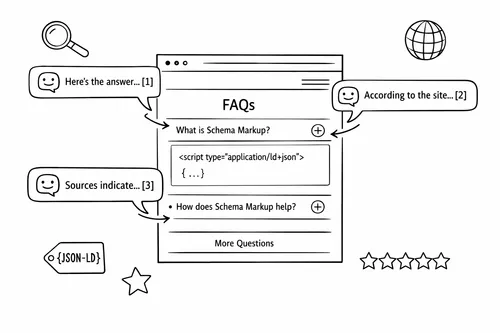
Structured data is how you translate your content into a language AI engines parse natively. Mark up your content with FAQPage, HowTo, Article, Organization, and Product schemas. AI engines use these markup types to understand what your page is about and extract facts with confidence.
This is table stakes. If you’re not doing this yet, it’s the single highest-ROI item on this list. A properly marked-up FAQ page is dramatically more likely to get cited than the same content without schema. JSON-LD is the preferred format: embed it in your page’s <head> and keep it synchronized with the visible content.
4. Semantic HTML
Use proper HTML tags (<header>, <nav>, <main>, <article>, <section>, <footer>) instead of generic <div> elements everywhere. AI engines parse semantic structure to understand what different parts of your page contain. A <main> tag tells the model “this is the primary content,” while an <aside> says “this is supplementary.”
This isn’t just a GEO improvement. It also helps accessibility, traditional SEO, and overall code quality.
5. Open Graph Tags, Meta Descriptions, and Canonical URLs
These three technical elements work together:
- Open Graph tags control how your content appears when shared on social platforms and give AI systems additional context about your pages.
- Meta descriptions (120-160 characters) provide concise page summaries that AI engines can use to understand what each page covers.
- Canonical tags with absolute URLs prevent duplicate content issues and tell AI engines which version of a page to reference.
None of these are new concepts if you already do SEO. But verify they’re present and accurate on every page, not just your homepage. For European businesses operating in multiple languages, hreflang tags are equally important. They help AI engines serve the right language version when a user prompts in French, Dutch, or German.
Content Strategy
Technical foundations get AI engines to your door. Content strategy gets you cited. These are the content patterns that AI engines reference most often.
6. FAQ Pages with Clear, Concise Answers
AI engines love the question-answer format because it maps directly to how users query them. When someone asks Perplexity “How do I automate customer follow-ups?” or asks Mistral’s Le Chat “What’s the best CRM for GDPR compliance?”, the engine looks for pages that literally contain that question followed by a direct answer.
Each FAQ should be one clear question with a direct, concise answer of two to three sentences. Avoid walls of text. Don’t bury the answer in the third paragraph. Lead with it. Structure matters more than word count. A 50-word FAQ that directly answers the question will get cited over a 500-word essay that eventually gets around to it.
Group your FAQs by topic on dedicated pages rather than dumping them all on a single “/faq” page. This helps AI engines associate specific questions with specific expertise areas on your site. For bonus points, mark them up with FAQPage schema and use HTML <details> elements for interactive display.
7. E-E-A-T Signals (Experience, Expertise, Authority, Trust)
Google introduced E-E-A-T, but AI engines have taken it further. Content with strong credibility signals tends to get surfaced and cited more often. Here’s what matters:
- Author bios with credentials. Not “John is a marketing enthusiast.” Instead: “John has 12 years of experience in B2B lead generation and has managed $2M+ in ad spend.”
- Case studies with real results. Specific numbers, named clients (with permission), before-and-after comparisons.
- Published dates. AI engines prefer fresh, dated content over “timeless” articles with no publish date. An article from March 2026 about AI search optimization is more citable than an undated “ultimate guide.”
- Client testimonials with names and companies. Anonymous praise doesn’t register as a trust signal.
The pattern here is specificity. AI engines are trained to distinguish between vague authority claims and verifiable ones.
8. Comparative and “Best Of” Content
AI engines frequently cite comparison pages because users frequently ask comparison questions. “What’s the difference between custom tools and enterprise SaaS?” “Best AI chatbot platforms for European e-commerce?” These queries need structured, balanced answers.
Create honest “X vs Y” articles and “Best tools for Z” lists. Position your product or service in these comparisons, but do so honestly. Include competitors and explain the tradeoffs. AI engines are sophisticated enough to detect when a comparison page is just a disguised sales pitch, and they’ll cite the balanced source instead.
We wrote about this tradeoff in Custom Tools vs Enterprise SaaS, which lays out the real cost comparison without pretending there’s only one right answer. That kind of honesty is exactly what makes content citable.
9. Proof Points: Stats, Case Studies, Testimonials
AI engines cite specific numbers and results. “We reduced email response time by 73%” gets cited. “We improve efficiency” does not. This is the single biggest difference between content that gets picked up by AI engines and content that gets ignored.
Every claim should have a proof point. Every service page should reference a specific outcome. If you don’t have exact numbers yet, run a pilot, measure the results, and publish them. A case study with real metrics is worth more for GEO than ten blog posts full of general advice.
10. Internal Linking and Information Architecture
Clear site structure helps AI engines understand your expertise clusters. If you have ten articles about voice AI, a services page about conversational agents, and three case studies about chatbot deployments, those pages should all link to each other. The AI engine then recognizes your site as a deep source on voice AI, not just a site that happens to have one article about it.
Build hub-and-spoke content architecture: a pillar page covering a broad topic, with supporting articles that go deep on subtopics, all linking back to the hub. Topic clusters with clear internal links signal to AI engines that you own a subject area.
Your GEO Action Plan
If you want a quick baseline, our GEO Ready Score checks the technical signals listed above in seconds. From there, here’s the priority order we recommend:
- Technical foundation first. Fix your robots.txt, add llms.txt, and implement JSON-LD markup on your existing pages. These are the quickest wins. They can improve AI visibility quickly, sometimes within days, depending on crawl and refresh cycles.
- FAQ pages next. Take your most common customer questions, write direct answers, mark them up with
FAQPageschema, and publish. This creates new, highly citable content with minimal effort. - Content strategy last. Glossaries, comparison articles, and case studies take more time but build the long-term foundation. Prioritize topics where you have genuine expertise and real data to share.
This isn’t a one-time project. AI engines update their source preferences regularly. We recommend re-checking your GEO score after significant website changes, when adding new content sections, after updating your technical configuration, and quarterly as a baseline. The businesses that get cited consistently are the ones that treat GEO as an ongoing discipline, not a one-time checklist.
Getting Started
The shift from search rankings to AI citations is already underway. The businesses that show up in AI-generated answers are the ones that treat their content as structured, verifiable data, not just marketing copy. The good news: most of the work overlaps with what you’re already doing for SEO. The difference is intention.
At Flowful, we help businesses structure their content and technical setup for AI-first discovery. It’s what we do every day, and we’d be happy to help you get started.
Get your free GEO Ready Score, then book a 30-minute audit to turn insights into action.