
Your clients are asking their web agency about AI. They want an AI agent like the one they saw on a competitor’s site, help with the emails piling up, someone to answer the phone after hours. Saying no sends them elsewhere. Hiring an AI engineer before the work exists is a cost the first projects will not cover. Quoting a custom build for every request is slow for you and expensive for them.
There is a better answer: split AI work into three piles. Some of it you resell as a product. Some you build for one client. And some you should use in your own agency first.
Key takeaways
- Resell what many of your clients need in the same way: an AI agent on their website, booking, phone answering, email replies.
- Build only when the work depends on one client’s systems or an unusual process, and start with a proof of concept.
- Use it yourself on audits, lead magnets and proposals. You learn what AI does well and get a demo to show.
- Settle maintenance before you sell. Decide who fixes its wrong answers and who updates it when the client’s offer changes.
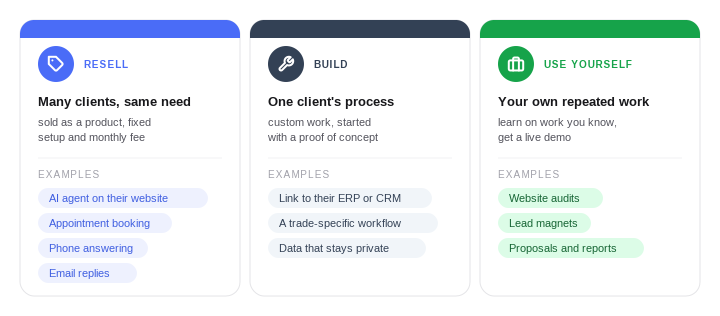
Resell: the same need across many clients
A product is worth reselling when many of your clients need it, its price is known upfront, and someone else runs it. The usual candidates:
- An AI agent for their website for any client whose contact form fills up with the same questions. You already built the site, so you know the content it should answer from.
- Appointment booking and an AI phone receptionist for local businesses: clinics, salons, trades, anyone who loses customers when the phone rings during an appointment.
- Email automation for clients with a shared inbox full of order, delivery and quote requests.
- A helpdesk like TicketFlow for clients whose support has outgrown a shared mailbox.
These sit naturally next to hosting and maintenance in a retainer. The client keeps one supplier, and you add a recurring line without adding a technical team.
Build: when one client’s process is different
Other requests fit no product. The client wants the AI to read their ERP, follow a workflow specific to their trade, or work with data they will not put into a generic tool. That is custom work.
Do not quote the full build on day one. Nobody knows yet how well the AI will handle the client’s real data, so start with a proof of concept: one or two weeks, one narrow case, tested on real examples. It gives you and the client a working thing to judge, and a far safer basis for the full quote.
Start with your own agency
The work your team repeats every week makes a good first project: you know it inside out, and nobody needs convincing. A few we have built for agencies:
- Website audits. An audit tool we built for an agency turned an hour of manual checks into a branded report generated in minutes. It also works as a lead magnet on the agency’s own site.
- AI lead magnets. A form on your site that gives a prospect something personal, such as a tailored PDF or a generated image, converts better than another ebook.
- Proposals and reports. Drafted from structured inputs, so the work nobody bills for stops taking a day.
You see what AI does well on work you know, and when a client asks, you show them a tool running in your own agency instead of a slide.
How to decide
| Question | If yes |
|---|---|
| Do several of your clients have this exact need? | Resell a product |
| Does it depend on the client’s own systems or an unusual process? | Build it, starting with a proof of concept |
| Is it work your own team repeats every week? | Use it in-house first |
| None of the above? | Wait until a client asks twice |
Before you resell: who does what
The question that sinks most agency AI offers is not the technology. It is who answers when an AI agent gives a wrong answer, and who retunes it when the client changes their returns policy.
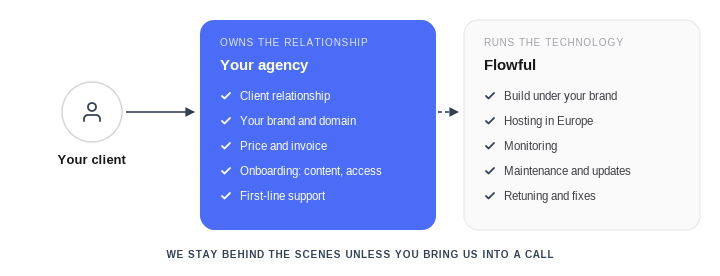
Settle these before the first sale:
- Maintenance. Who monitors the answers, fixes mistakes and updates the knowledge base when the client’s offer changes?
- Brand. Does the client see your name, or the provider’s? Can the provider join a technical call as part of your team?
- Pricing. A fixed setup and monthly cost from your provider lets you set your own retail price and know your margin before you quote.
- Data. Where is it hosted, and is there a signed data processing agreement? A larger client will ask on the first call.
- The odd request. What happens when a client wants something the product does not do? You need a path to custom work that does not take the client away from you.
Where to start
Pick one client, not a whole offer. The best first candidate has a busy contact form or the same questions coming in every week, and already trusts you with their site. A demo built on their own content will do more than any slide.
Where we come in
We work with agencies in both directions: you resell our packages under your brand while we build and run them, and we automate the parts of your own agency that do not scale. See how it works on our page for digital agencies.
To look at your client base together and find the first good fit, book a discovery call.