
Short answer: it depends on which door you use. Type a customer email into a free ChatGPT, Claude or Gemini account and, with most providers, that conversation can be used to improve the model unless you change a setting. Go through a business plan or the API, and it is not used for training by default. Same model, different contract.
Key takeaways
- Personal accounts train by default with most providers. Free and paid personal plans are consumer products, and the setting to turn training off is yours to find.
- Business plans and APIs do not. ChatGPT Business, Claude Team, Gemini in Workspace, Microsoft 365 Copilot and the APIs exclude your data from training by default.
- Training is not the only question. Retention, human review, hosting region and a data processing agreement matter as much.
- Your staff probably use the wrong door. A personal account at work is the consumer door. Give them a business one.
Two doors to the same model
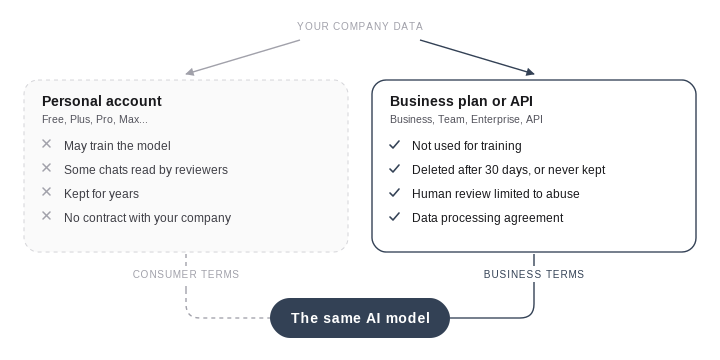
Here is where the main providers stand in October 2026. Settings move, so check the provider’s own page before relying on this table.
| Provider | Personal account | Business plan or API |
|---|---|---|
| ChatGPT | Free, Plus and Pro chats can train the model unless you turn off “Improve the model for everyone” | ChatGPT Business, Enterprise and the API: not used for training |
| Claude | Free, Pro and Max ask you to choose. If you allow it, chats are kept for up to five years | Team, Enterprise and the API: not used for training |
| Gemini | A personal Google account can have its chats used for training, and some are read by reviewers | Gemini in Google Workspace: not used for training |
| Copilot | Personal Copilot may use conversations unless you switch it off | Microsoft 365 Copilot: not used for training |
| Mistral (Vibe, formerly Le Chat) | Free and personal plans can train on your chats unless you opt out in settings | Enterprise: off by default |
“Not used for training” is a promise in the terms, not something you can verify yourself. It is still a far better position than a consumer account, where the default works against you.
The questions after training
Once training is off, four things still decide whether company data is safe with an AI provider.
- Retention. Business plans and APIs typically keep requests for up to 30 days to detect abuse, then delete them. Most providers offer zero retention on request, so nothing is stored at all.
- Human review. Consumer products let staff read a sample of conversations. Business terms rule it out or limit it to abuse cases.
- Where it runs. By default, the big models run in the United States. OpenAI offers European processing for its API and enterprise plans, Claude models are available in EU regions through AWS and Google Cloud, and Mistral is French. Our sovereign AI guide compares the options.
- A contract. The GDPR requires a data processing agreement with anyone who processes personal data for you. Business plans come with one. A personal account does not, which makes it the wrong tool for customer data whatever the training setting says.

Your team probably uses the wrong door
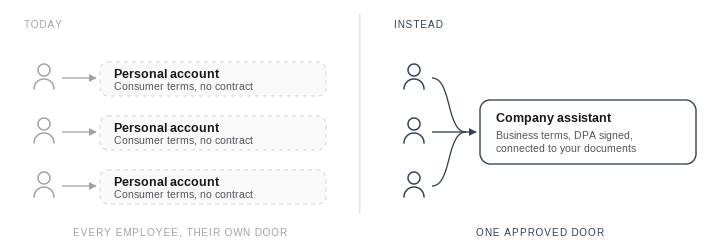
The question usually comes from a business owner thinking about a chatbot or an automation project. The bigger exposure is already in the building: staff with personal ChatGPT accounts pasting customer emails, contracts and spreadsheets into the consumer door, because it is the one they know.
A ban rarely works. What works is a sanctioned assistant on business terms, connected to the documents people actually need, so the approved tool is also the most useful one. That is the case for an internal chatbot, and we wrote about the shift in From chaos to control.
What we do with your data
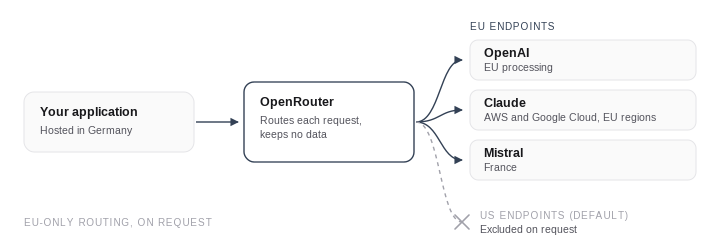
Everything we build goes through the business door. Your data never trains a model, ours or anyone else’s, and our data processing agreement extends that ban to every AI provider we use. Applications and backups run in Germany. Model calls go through OpenRouter, which sends each request to the provider we pick and keeps no data itself. By default, those providers may process requests outside the EU, mostly in the United States; on request, OpenRouter routes to EU endpoints only, so a request never leaves Europe. Or everything runs on your own servers. The details, including the DPA, are on our security and data page.
Conclusion
Personal AI accounts may train on what you type. Business plans and APIs do not, keep less, and come with a contract. Move your team to the business door, ask every provider about retention and hosting, and sign a DPA before any customer data goes in.
If you want to see what that looks like for your business, book a discovery call.