
Between 11 August and 29 September 2026, xAI (now part of SpaceX), Meta and OpenAI shipped the same product: an agent that belongs to one person, runs day and night on its own cloud computer, remembers what you told it and acts on your behalf. xAI calls it Grok Bot, Meta calls it Muse, OpenAI calls it Dots. An open-source version, Hermes, has existed since February 2026.
What does this change for a company of 10 to 200 people in Belgium or France? A lot for your employees, very little for your company.
Four products, one architecture
- One cloud computer per agent, with a browser, a terminal and files. It keeps going when you close your laptop.
- Persistent memory. It remembers last week and learns how you like things done.
- A human at the checkpoint. Before a purchase or a sent email, the agent asks. Meta went furthest: a second agent, Sentinel, checks everything, and nothing Muse does reaches the internet without its approval.
- Consumer connectors. Gmail, calendars, Slack, Stripe, Shopify. Dots reach more than 4,000 apps through OpenAI’s plugins.
Who sells what
Prices and availability as of 14 October 2026.
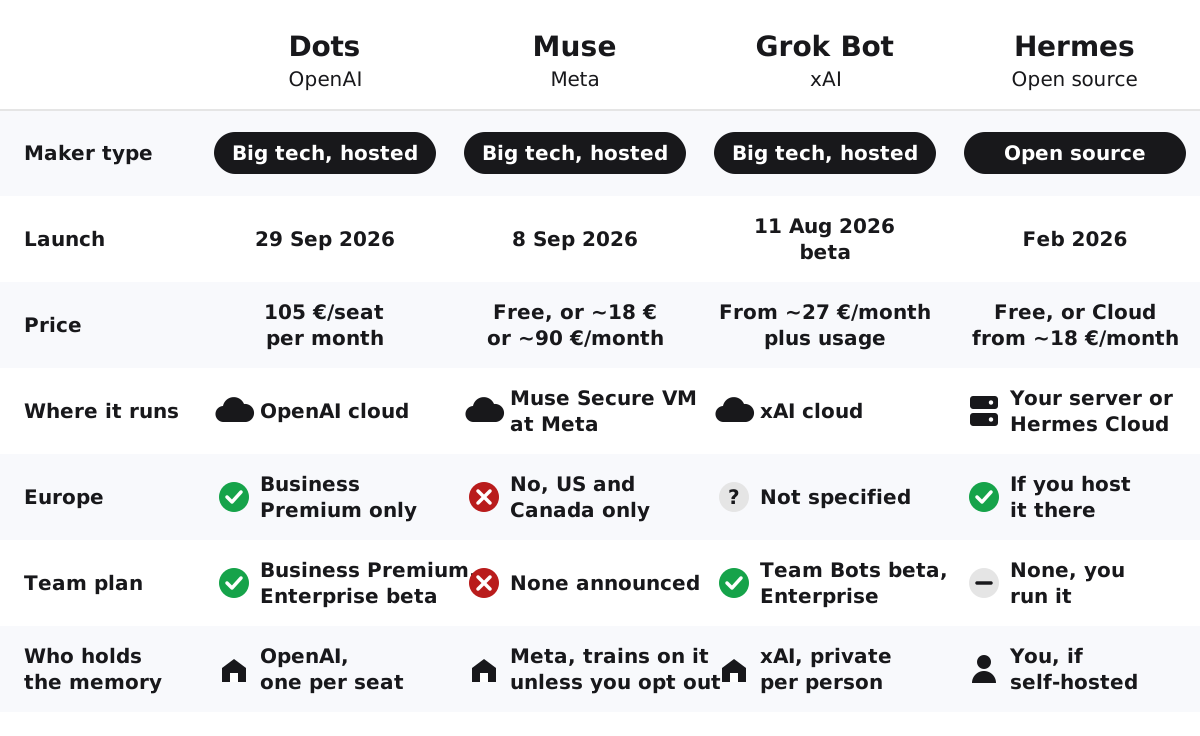
Dots is the most complete offer on paper: GPT-6 Astra, answers in ChatGPT, Slack or Teams, background research. The launch was less convincing: three weeks after Muse, on stage at DevDay, the voice demo stayed silent several times and OpenAI blamed several updates rolled out at once. It looks like a product shipped in a hurry to answer xAI and Meta. In Europe, the ChatGPT release notes exclude Pro users at launch, but Business Premium is rolling out everywhere. So yes, a Belgian company can use Dots, for individual productivity. At October 2026 prices, Business Premium costs 105 € per user per month billed annually, so around 12,600 € a year for a team of ten, one dot per person, with the data at OpenAI and no shared agent.
Muse has the most careful security design on paper: Meta promises that nothing leaves the agent’s machine without Sentinel’s approval. In practice, your interactions train Meta’s models unless you opt out, and on 20 September Amazon blocked Muse from its store: the agent browses without identifying itself and, according to Amazon, appears to capture and store customer credentials. $20 or $100 a month, about 18 or 90 €, US and Canada only.
Grok Bot is the most team-oriented, with an Enterprise edition and Team Bots you can invite into a Slack channel. It is xAI’s product, sold with both Grok and Cursor subscriptions since SpaceX agreed to buy Cursor in June.
Hermes is the open-source alternative, and the main challenger to OpenClaw, the personal agent developers were running on their own machines in early 2026. Why it is gaining ground: one Python install instead of a gateway to architect, any model including your own endpoint, one gateway to Telegram, Slack, WhatsApp and email, and an agent that writes itself new skills after a complex task, so it gets better the more it is used. MIT licence, more than 250,000 GitHub stars. The trade-off: you run the server and the security, and OpenClaw’s own comparison points out that Hermes relies on the operating system as its only barrier against a misbehaving model. Hermes Cloud hosts it from $20 a month, about 18 €, plus model costs, and the hosted service collects prompts and outputs unless Privacy Mode is on.
What actually changes
The level of expectation. By 2027, some of your customers and employees will have an agent that reads their email and compares prices for them. A customer whose agent writes to your sales team at 11 pm expects an answer at 11:05 pm. An employee whose agent sorted their inbox overnight will not accept a CRM that needs five clicks per record.
What they do not do for an SMB
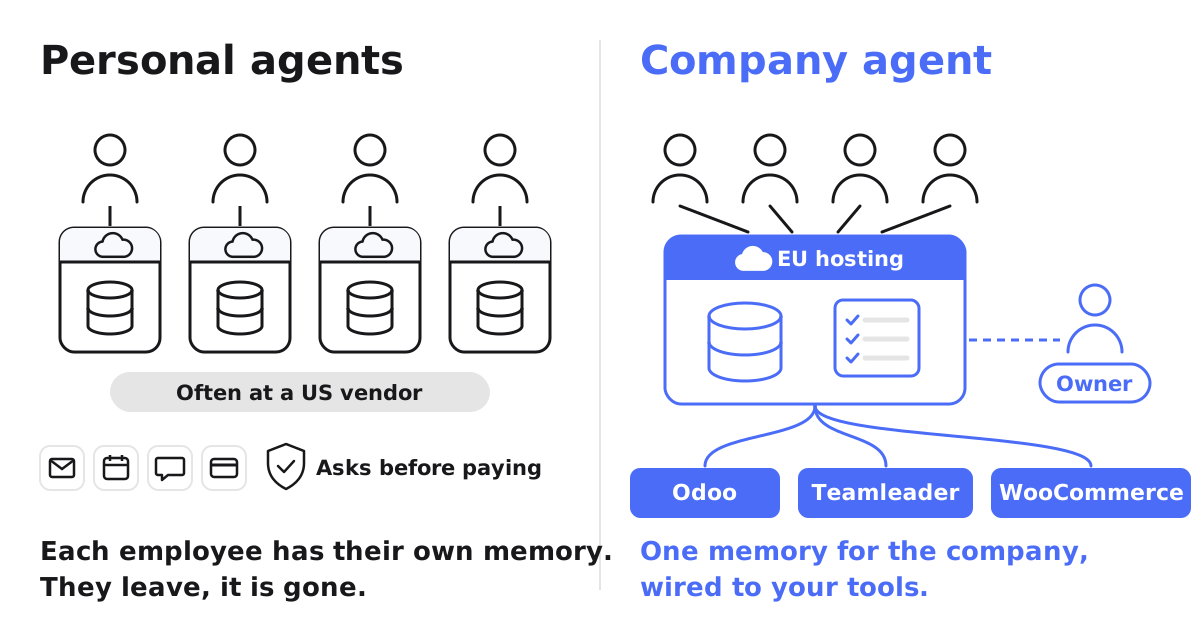
- They are personal, not shared. One dot per seat, and even xAI’s Team Bots, which share skills and context across a team, keep each person’s conversations and memory separate. Ten people on Business Premium cost about 12,600 € a year, for ten separate memories.
- They do not know your tools. Shopify, QuickBooks and Stripe, yes. Your Odoo, your Teamleader, your WooCommerce catalogue, no.
- Your data sits with a US vendor, when the product is available in Europe at all. Under GDPR, customer data needs a processing agreement and an answer when a customer asks where it went.
- Direct access is always a risk. An agent that holds your mailbox, your payment card and your customer accounts can act on a bad instruction, including one planted in a web page or an email it reads. Those permissions must stay configurable at company level, per tool and per action, not left to each employee’s settings.
- They lock you into one model. Dots only runs on OpenAI’s models, Muse on Meta’s, Grok Bot on Grok. If the model regresses, gets more expensive or is simply wrong for a task, there is nothing you can do. A custom agent switches models per task, on performance, cost or hosting, without the company changing tools.
- Nobody is accountable. When an employee’s agent answers a customer wrongly, who owns the mistake? OpenAI itself asks you to review consequential work.
The security risks, said plainly
These agents are free or cheap, install in ten minutes and work from a phone. Your employees will use them whether you decide anything or not. That is the shadow AI problem, and with an agent it is worse than with a chatbot: the agent does not just read, it holds credentials and acts.
- Company data leaves without anyone noticing. An employee connects their work mailbox or a CRM export to a personal agent, and customer data is now on a US vendor’s server, in a memory the company cannot see or delete. For Muse, it also trains Meta’s models unless the person opts out.
- The agent holds the keys. To act, it stores passwords, session cookies and payment details. Amazon’s complaint against Muse is exactly that. If the account or the vendor is compromised, so is everything the agent could reach.
- It can be manipulated. An agent that reads web pages and emails can be given instructions by them. A crafted email can tell it to forward a file or change a bank account number. The vendors’ checkpoints reduce this. They do not remove it.
- No audit trail for the company. When a customer asks what happened to their data, or an auditor asks who sent what, there is no central log. Only a personal history on a personal account.
What to do now: write a one-page policy that says which data may never go into a personal agent, require work accounts to stay disconnected from personal agents, and give teams a company agent for the work that touches customers, so they do not need a workaround.
Personal agent or company agent
A personal agent is a good tool for one person’s own work: inbox, meeting prep, research, drafts. Used that way, with no customer data, it is already useful.
It stops being enough as soon as the work belongs to the company. Its memory leaves with the employee. It shares no business rules with colleagues. It does not connect to your tools, and nobody answers to a customer for what it did.
Agents are not new to us. We have been building them at Flowful since 2024, shared ones for a whole team and individual ones for a single person, and we have tested these four. The lesson is the same every time: an agent is worth what its wiring is worth. A company agent is one agent on one backend, wired to the tools you actually run, with a memory the company owns, hosted in Europe under a processing agreement, with written rules, an action log and a named owner. One agent that works for the company, rather than ten agents for ten people.
What we recommend
Let your teams try personal agents for their own work, with no customer data. It is the best training there is. For anything that touches a customer, an order or a shared process, choose a company agent. Personal agents will make your customers and employees more demanding. Better to have yours before they do.
Tell us about your case, or see our internal chatbot package.